This year we celebrated our nation’s 250th birthday. Several special events led up to July 4, and there are more to come. With this extra special emphasis on America’s independence, it feels appropriate to celebrate our freedom in Christ, doesn’t it? No matter your political persuasion, you’ve likely felt a growing sense of frustration with the polarization, name calling, and vitriol that seem to dominate our news outlets and social media feeds. It all feels too much sometimes. So let’s turn our focus from the national culture crisis and ask ourselves, What does freedom in Christ look like?
It’s a question I’ve wrestled with over much of the last five years. I have Crohn’s disease, and in late 2021, we discovered that the persistent inflammation in my gut had turned into a malignant tumor. Cancer became a part of our family’s daily experience and DNA. It’s not a story I would have chosen, and if I’m honest, the burden of chemo, unwanted, crippling side effects, and general malaise have all felt stifling to the free, abundant life Christ promised.
Maybe you feel a similar bondage too. Your story doesn’t have to be like mine. In fact, we have an unhelpful habit in the church of comparing pain. We tell ourselves that we aren’t allowed to complain or share in sacred spaces because our story isn’t as “heavy” or “tragic” as someone else’s. That’s a ploy of the enemy to keep us further in bondage and far from even the fringes of freedom in Christ. No matter your pain, let’s not do that. Your story is safe here. Whether caring for an aging parent, struggling with estrangement from an adult child, reeling from church hurt, watching a loved one battle addiction, or being dangerously low on hope, we know what it feels like to be shackled to fear, anxiety, worry, regret, shame, and any number of unhelpful feelings that keep us from experiencing freedom in Christ.
How do we hold the liberty and joy Christ promised when we are in the midst of suffering? Should freedom in Christ insulate us from pain and heartbreak? No. Not this side of heaven anyway. If freedom doesn’t mean free from suffering, what does it mean?
Suffering Is Sanctifying
Over the last five years, here’s the truth to which I’ve been clinging: Jesus is much more interested in my holiness than my happiness. How does cancer contribute to my holiness? In our suffering, God is up to something more eternal and profound than we often give Him credit for. Suffering is sanctifying. Sanctification is a big church word that simply means I should look more like Jesus tomorrow than I do today. I should look more like Jesus and, by necessity, less like myself. You see, Jesus isn’t interested in a better me, He’s interested in a deader me. This is the heart of Galatians 2:20, “I have been crucified with Christ, and I no longer live, but Christ lives in me. The life I now live in the body, I live by faith in the Son of God, who loved me and gave himself for me.”
I wouldn’t trade this cancer season of my story because I look more like Jesus today than I did five years ago. Please don’t misunderstand me. I can’t take any credit. This is the good news. I look more like Jesus because the gospel works. This thing we’ve given our lives to, what Christ died for, actually works! The gospel gives purpose to my pain.
Suffering Isn’t Punishment
Our pain isn’t a punishment. Cancer isn’t a punishment for me — not because I don’t have plenty of sin issues that need to be addressed, but because all those and countless more were fully paid for in the substitutionary death of Jesus Christ on the cross. When we wrongly believe that suffering is a punishment for sin, we are saying that Jesus’ work wasn’t sufficient.
Instead of wrongly believing we are being punished, we should look at the fruit growing in our lives. Even when our circumstances stink and heartache seems a constant companion, Jesus is still at work in us.
Chemo makes me weak and moves me to trust in the sufficiency of Christ for getting through the everyday tasks of being a wife and a mom. The uncertainty of my life on earth compels me to live with an urgency for the gospel I didn’t have five years ago. The heaviness of cancer reframes all of life’s frustrations, making me more patient and forgiving. The weariness in a chemo suite invites me to bring the light and love of Jesus to those sitting around me. The grace extended to us in car rides for our boys, in meals for our family, and in countless other gifts of grace have taught our boys the beauty of the body of Christ. Sleepless nights that tempt me to worry and fear instead turn to sweet intercession with my heavenly Father and Friend. When I do give in to anxiety and what-ifs, I’m comforted by my faithful, unwavering husband. Our marriage grows stronger even in suffering.
I don’t know what you’re carrying or the story you’ve been asked to steward, but I can tell you that even in this season, you can enjoy freedom in Christ. Freedom to look beyond the pain of today to the promises of heaven. Freedom to trust the loyal love of a Savior who never leaves us. Freedom to look at the fruit growing in you and proudly proclaim, “The gospel works!”
About Whitney Capps

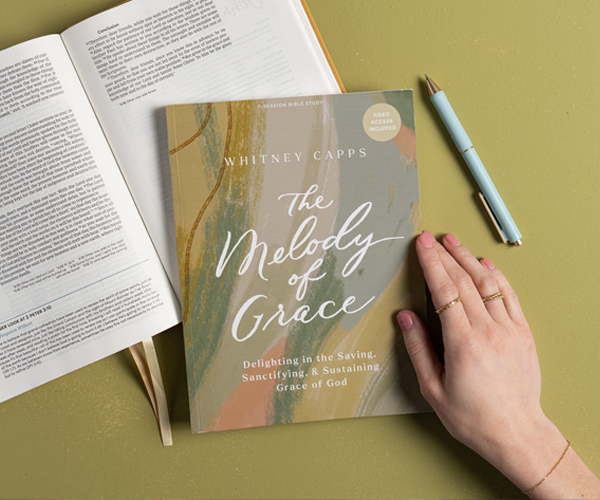
Whitney Capps is a Bible teacher and author of Sick of Me and the We Over Me and The Melody of Grace Bible studies. She is founder and CEO of Simple Seminary, an online learning platform that teaches women theology in a simple, accessible format. Whitney and her husband, Chad, live just outside Atlanta raising their four boys. She’s a cancer survivor, tired mama, and happy shoe collector.
About The Melody of Grace Bible Study

In this 7-session Bible study, Whitney Capps will examine passages throughout the Bible to explore the transformative power of grace. We’ll see how grace shows up in every season of our stories and is active in every area of our lives as followers of Christ. We’ll dive deep into the multifaceted beauty of God’s grace: grace that saves us, grace that grows us in Christ, and grace that sustains us through the darkest valleys. We’ll be reminded that grace is not only something we receive, but it’s something we extend. Come learn to receive grace fully, live it freely, and share it boldly, experiencing the sweet sound of grace as it flows through you. Read an excerpt from this study here.