Today we’re sharing an excerpt by Marissa Sullivan from our new Advent study, All Who Draw Near.
I went to college in Jackson, Tennessee. And while I was there, I considered it my home. But when Christmas break rolled around each year, I would eagerly make the two-hour drive east to my “real” home, the place I grew up and called home for eighteen years. I remember pulling into my parents’ driveway at the beginning of one Christmas break, finding Bing Crosby’s “I’ll Be Home For Christmas” on my phone, and turning the volume all the way up as I walked into the kitchen.
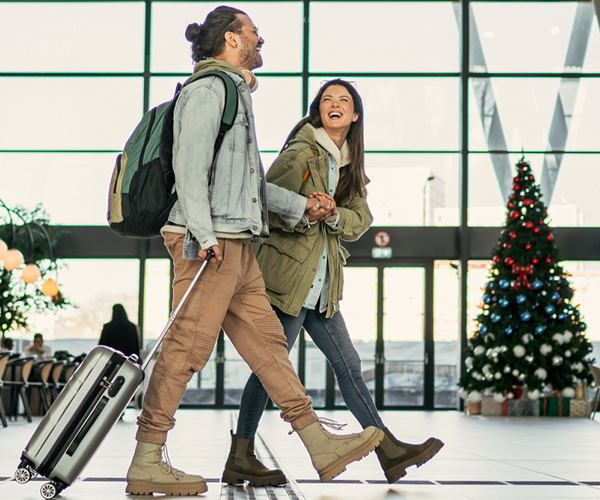
Many of us have experienced going home or having family members come home for Christmas. But long before going home for Christmas meant navigating traffic jams and bustling airports, one young couple made the journey home for the very first Christmas.
In Luke 2:1–7, Joseph and Mary traveled to Bethlehem, where Jesus was born. As we consider these moments in the Christmas story, it helps to keep in mind the five basic questions of journalism: who, what, when, where, and why.
When considering the who of this story, let’s look first at Joseph. Luke specifically pointed out that Joseph was “of the house and family line of David” (v. 4)—the family the promised Messiah was to come from.
With Joseph was Mary, his pregnant fiancé. Her presence seems a bit unusual, especially given the circumstances. Perhaps it was required of her in this instance, but women weren’t usually required to register.
Perhaps Mary wanted to be with Joseph as the time drew near to give birth to her son. Or Joseph may have asked her to come so she wouldn’t have to endure scrutiny from the people of Nazareth alone.
The what and where of this passage focuses on the couple’s travel from Nazareth to Bethlehem—an eighty-five to ninety-mile journey. Although Joseph and Mary lived in Nazareth (Luke 1:26-27; 2:4), they were traveling to their ancestral home.
Luke didn’t give a precise time for these events, but he introduced them with the phrase In those days (v. 1). This vague phrase indicated that “all that follows must be understood as falling under God’s sovereign rule.”1
Finally, the why. Luke stated that these events were taking place because of a decree from Caesar Augustus “that the whole empire should be registered” (v. 1). There’s little consensus among scholars about the exact nature of this census, but whatever the case, the effect of the emperor’s decree from Rome reached all the way to the home of Joseph and Mary.
The emperor wasn’t intending to play a role in bringing about God’s design, but it turns out God uses all kinds of people to bring about His purposes.
I wonder what might change if we lived with complete confidence that God is orchestrating every circumstance in the world according to His design.
While Mary and Joseph were in Bethlehem, “the time came for her to give birth” (v. 6). This timing wasn’t an unfortunate coincidence. Rather, it placed Mary exactly where God wanted her to be to deliver the Messiah.
The time had come.
The apostle Paul described it this way:
When the time came to completion, God sent his Son, born of a woman, born under the law to redeem those under the law, so that we might receive adoption as sons. Galatians 4:4-5
According to Scripture, the events took place at the right time in history to fulfill all of God’s purposes and plans.
We don’t know the exact setting of His birth, but it is clear there was no glamour in this event. Mary swaddled Him and laid Him in an animal’s feeding trough. That was not the most suitable place for a newborn, but there was no place else in the busy village. In the midst of these circumstances, the God of creation had been born to those He created—helpless and dependent on frail humanity.
Let’s look at one more instance of how this quiet birth in an obscure village was orchestrated and guided by the sovereignty of God.
Micah 5:2 says, “Bethlehem Ephrathah,
you are small among the clans of Judah;
one will come from you
to be ruler over Israel for me.
His origin is from antiquity,
from ancient times.”
More than four hundred years before Joseph and Mary’s journey, the prophet Micah wrote these words, communicating God’s promise that the Messiah would be born in Bethlehem.
For Mary and Joseph, their journey to Bethlehem was a response to their circumstances, but God was overseeing all of the details.
As Joseph and Mary traveled home for what would be the first Christmas, God was positioning them to be right where He intended for them to be for this particular moment.
As you make plans for this Christmas—whether you’re traveling or staying home, gathering with many or few, keep in mind that God is still at work in our world. As God used Joseph and Mary’s ordinary journey to fulfill His promise for His plan of redemption, He wants to use you to accomplish His continuing purpose of seeking and saving the lost.
Surrender your journey to Him and see what great things He does.
Want to learn more about the All Who Draw Near Advent study? Flip through the study in the video below or view a free sample of the Bible study book.
Work Cited
1. Robert A. Stein, Luke, vol. 24, The New American Commentary (Broadman & Holman Publishers, 1992), 230.