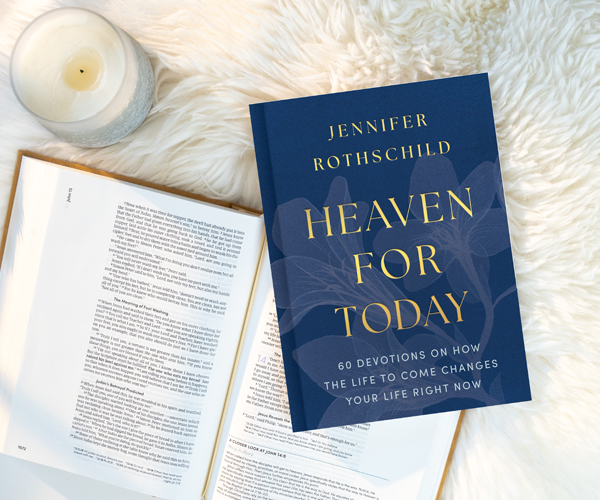
This is an excerpt from Jennifer Rothschild’s new devotional, Heaven for Today.
“Your dead shall live; their bodies shall rise. You who dwell in the dust, awake and sing for joy! For your dew is a dew of light, and the earth will give birth to the dead.” Isaiah 26:19
Heaven. It is our glorious unending, when our faith becomes sight. It is our true country, our Father’s House (Phil 3:20; Jn 14:2). And it is the place of no more tears, sorrow, crying or pain (Rev 21:4).
The big problem with Heaven, though, is that we have to die to get there. And can we be honest? We may be made for eternity, but most of us really appreciate longevity. We fear death because it is often shrouded in the unknown.
We don’t know what it feels like to die. We don’t know what it is like to close our eyes to this earth and open them in Heaven. Perhaps we can use our imagination and compare it to something we do understand: a birth.
Imagine a little baby nestled safely in her mother’s womb. She grows there, safe and sheltered. That warm cocoon is her whole world.
Yet her world is so very tiny and dark. Like a fish in an aquarium doesn’t know water is wet, and has no idea he’s surrounded by invisible walls, that tiny baby doesn’t know she is confined, crowded, with no air, no light.
Her mother marvels at how every kick and elbow is met with boundaries. Each poke and nudge, another reminder that the baby’s tiny world can hardly contain her. Oh, the mother thinks, how this child must be ready and longing to come out into this world where it is bright and boundless.
But the baby? She is content. She simply can’t conceive that her world is not the world. She doesn’t know the dark is dark until it is her time to travel through the birth canal and be born into the world she was created to live in…the world of light, air, and boundlessness.
Could that be what it feels like to die?
Here on this side of eternity, we think this world is it. We think we know shelter, freedom, and light. But in reality, we only see the shadows and hear the whispers of another world just beyond us. We only fear dying to this current world because we really don’t know what it feels like to be fully alive in the future world of radiance, splendor, and endless joy.
There will be a day when each of us travels through that “birth canal” and awakens to the true light, to boundless freedom and love, to live in the world we were created for and be with the One who created us for Himself.
Do you think of death this way? As a birth? Or do you shy away from talking or thinking about death due to fear and dread? I suppose it is only right to feel negative emotions toward what the Bible considers a great “enemy” of life (1 Cor 15:26). Death indeed feels shattering, emptying, and totally counterintuitive, and well it should, for Eden had no tombstones.
But there is a difference in mourning death and fearing it. For death is defeated. Try as it may to make its blow a fatal one, it cannot. Because of Christ, death may take a swing at us, and we may fall into the burial ground from the impact, but sure as the sun rises, we get back up. We rise in resurrection from the ashes, like a hidden seedling sprouting out of the soil. Life pushes us out to the other side.
Poet George Herbert wrote on this very idea when he said, “Death used to be an executioner, but the Gospel makes him just a gardener.”1 Tim Keller expanded that thought, “Death used to be able to crush us, but now all death can do is plant us in God’s soil so we become something extraordinary.”2
So it is with birth. Delivering a baby comes with anguish and sorrow as the mother feels the pain and the baby even cries as it loses a prior world. But, just as Jesus himself teaches, all that momentary sorrow and fear gives way as something extraordinary unfurls: “You will weep and mourn…You will become sorrowful, but your sorrow will turn to joy. When a woman is in labor, she has pain because her time has come. But when she has given birth to a child, she no longer remembers the suffering because of the joy that a person has been born into the world. So you also have sorrow now. But I will see you again. Your hearts will rejoice, and no one will take away your joy from you” (Jn16:20-22).
Oh, my friend, death isn’t the period at the end of our stories. Death is the comma that transitions us from the prologue to the forever stories of our lives, allowing us to step fully into our glorious unending where we finally trade faith for sight. It is the birthing passage that propels us into the everlasting arms of the One who saved us and sealed us for eternity with Himself.
May we forever praise the God of Heaven—the One who can take a death sentence and turn it into a birth.
Work Cited
1. This phrasing is attributed to George Herbert, as it is adapted from two lines in his poem “The Temple” (1633).
2. Timothy Keller, On Death (Penguin Random House, 2020), 72.
About Jennifer Rothschild

Jennifer Rothschild has shared her inspiring messages to audiences across the country and through media outlets including Dr. Phil, Good Morning America, The Today Show and The Billy Graham Television Special. She is the author of many books and Bible studies, including Heaven, Amos, Take Courage, Psalm 23, Hosea, Me, Myself, and Lies, and more. Jennifer is a C. S. Lewis junkie, an obsessive audiobook listener, a dark chocolate lover and she drinks way too much strong coffee. She’s been blind since age fifteen and says the greatest lesson she’s learned in the dark is that it doesn’t have to be well with your circumstances to be well with your soul. Jennifer lives in Missouri with her husband, whom she affectionately calls her very own Dr. Phil.
About Heaven for Today

In Heaven for Today, beloved Bible teacher, speaker, and author Jennifer Rothschild offers 60 devotions to help you engage heaven now. Yes, the reality of heaven will be unveiled for you day by day in this book—but so will your ability to enjoy little slices of eternity right where you sit, contemplating its wonders and being comforted by its promises in your real life.