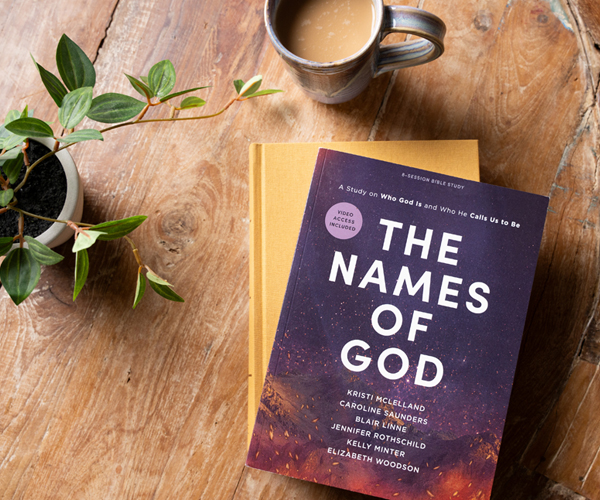
Today we’re sharing an excerpt by Kristi McLelland from The Names of God Bible study by Kristi McLelland, Caroline Saunders, Blair Linne, Jennifer Rothschild, Kelly Minter, and Elizabeth Woodson.
Excerpt from THE NAMES OF GOD Bible study
In Genesis 1–2, the Living God created everything to be in a forever state of shalom: universal flourishing, wholeness, harmony, sufficiency, and delight.
In Genesis 3, shalom was shattered. In four brief chapters, from Genesis 3 to Genesis 7, Adam and Eve ate the forbidden fruit, Cain killed his brother Abel, and the world became so violent that the Living God felt the need to flood, or de-create, it. What will the Living God do with this mess? Is there hope for the rest of the story of the Bible?
Skip to the end of your Bible and read Revelation 21–22. As you read the final two chapters of the Bible, look for language and details reminiscent of the creation account in Genesis 1–2, and more specifically the garden of Eden.
A deep and profound restoration of shalom is already underway. This is the story told in Scripture — it’s the trajectory of God’s work and the goal of His self-revelation.
The first name of God shows up just four words into the story: “In the beginning God … ” (Gen. 1:1). “God” here is the Hebrew elohim. The fifth word in the story of the Bible describes what God does: “In the beginning God created … ” (emphasis added). The first name of God is followed by a verb: created. This name followed by a verb is central to understanding the names of God throughout the Bible.
In the ancient world, names carried more significance than they do in our world today. Your name was your essential essence and character. Your name was your destiny, connected to what you would do in the world. In other words, your name was your verb. So, when we see a name of God throughout the Bible, our first question should always be, “What is God doing?”
Read Genesis 2:4 below.
“These are the records of the heavens and the earth, concerning their creation. At the time that the Lord God made the earth and the heavens … ”
The name for God used in this verse, “LORD God,” is Yahweh Elohim in Hebrew. It’s important to note that the addition of Yahweh makes God’s name more personal.
Amazingly, this personal name — LORD God — continues into Genesis 3. The transcendent God (elohim) of creation has come so close, so immanently near, that He is walking in His creation, in the garden of Eden, looking for Adam and Eve. He did not come near with rules or commandments, but with a question: “Where are you?” (3:9).
Why was God looking for Adam and Eve? The Living God was about to verb. He started by covering their nakedness.
When shalom was shattered, God began the restorative work of repairing the breach. A few verses later, in Genesis 3:15, God says, “I will put hostility between you [Satan] and the woman, and between your offspring and her offspring. He will strike your head, and you will strike his heel.” When God meets Adam and Eve in their shame, He presents them with the consequences of their sin. But He also presents them with the promise of salvation and redemption, the restoration of shalom.
The story of the Bible is the ongoing story of the Living God restoring, repairing, renewing, and redeeming shalom for humanity and the world through the death and resurrection of Jesus. He is making crooked things straight. He is making rough places smooth. Sin turned things upside down, but the Living God is turning things right side up again.
In Genesis 3, we get a gospel gorgeous hint. In the very moment when shalom was shattered, a phrase was used: “then the eyes of both of them were opened” (3:7a). In that moment, Adam and Eve’s eyes were opened to shame and death. This phrase would be echoed later in the story of the Bible.
Thousands of years later, Jesus, the Son of God, would resurrect in the borrowed tomb of Joseph of Arimathea. Jesus, the promised offspring of Genesis 3:15, defeated sin, shame, and death, and then He walked out of the tomb located just outside the city walls of Jerusalem. On that very day, on resurrection day, Jesus walked on the road to Emmaus with two of His disciples. Later that resurrection night, the two shared a meal with Jesus; they ate together. In a line so beautiful it makes me cry, we read this echo:
“It was as he reclined at the table with them that he took the bread, blessed and broke it, and gave it to them. Then their eyes were opened, and they recognized him” (Luke 24:30-31a, emphasis added). Their eyes were opened to recognize the resurrected Jesus and everything He accomplished through His life, death, and resurrection.
Their eyes were opened to sin, shame, death, and hell defeated.
Our stories do not end in shattered shalom. God the Father, Jesus the Son, and the Holy Spirit are even now continuing the work of restoring shalom. The Bible does not end in Genesis 3 or in Revelation 20. By the grace of God, there’s also Revelation 21–22. The story of the Bible ends with shalom restored.
Reflect on the restorative work God is doing even now in your life through your relationship with Jesus. Take a moment to say a prayer of gratitude to Him today.
Want to learn more about The Names of God Bible study? Watch the Session One video below for a sneak peek or view a free sample and teaching video clips here.