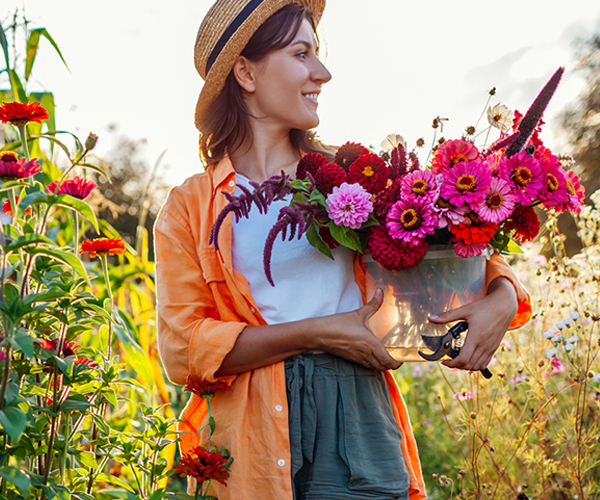
Do you have a favorite flower? My favorite is the zinnia. It’s such a bright, colorful flower with so much variety. When I was a little girl, my grandmother always kept a large flower bed at her house full of zinnias just for me. I could pick all I wanted and play with them to my heart’s content. This is one of my favorite memories about my grandmother.
As an artist, I’ve always been fascinated with symbolism and how people can convey meaning or impart an idea without words by using an everyday item to say something. You may not realize this, but there is meaning behind each type of flower, a language that has been used for many years to relay messages. I recently looked up what zinnias symbolize: they represent endurance, strong friendship, and long-lived affection. My grandmother probably didn’t know about this, but it made me smile to think she was using them to show me her love and affection.
The Victorians used flowers to send a message that they didn’t want to speak out loud by having a certain flower delivered. It was their silent dialogue with each other. Flowers could be used to relay a yes or no answer. A yes answer could be relayed by handing over the flowers with the right hand; if the left hand was used, the answer was no.1
People used to be aware of the meanings behind certain flower varieties, and they would use that particular flower to get their message across. A person could express friendship, love, and even displeasure by sending a particular flower. Even William Shakespeare spoke of the meanings behind flowers, especially in Hamlet. Scripture also uses the floral symbolism to convey an idea or thought. Here are some well-known ones you may recognize:
The Lily
Symbolism: Loveliness, purity, innocence
In Song of Solomon 2:1, some might see this as a description of Christ—His grace, purity, and accessibility to all. The lily mentioned here grows close to the ground in the valleys, representing humility. Jesus, who being in very nature God, humbled Himself to become a servant and die for humanity. The lily is also known for its sweet scent, and Jesus’s character and teachings are described as having a sweet fragrance. And as 2 Corinthians 2:14-15 tells us, we are now the fragrance of Christ since He lives within us.
The Almond Blossom
Symbolism: Vigilance and readiness, hope and promise, the Levitical priesthood, and the coming of old age
In Exodus 25:33-36 the golden lampstand in the tabernacle had almond blossoms on the shaft and the branches, symbolizing God’s presence and watchfulness. The Hebrew word for almond originates from the Hebrew word that means “to watch.”2 In Numbers 17:8, it is used to signifying God’s choice of Aaron and his descendants as priests. In Ecclesiastes 12:5, Scripture uses the blossoming almond tree to describe the weakness and aging process of humankind. The white blossoms are compared to the white hair of the elderly.
Hyssop
Symbolism: Purification and spiritual cleansing
In Psalm 51:7, the writer asks God to cleanse him from his sins using hyssop to show God’s forgiveness and mercy. In Exodus 12:22, hyssop was used to apply the lamb’s blood to the door posts to escape the judgement of the last plague. In Leviticus 14, hyssop is part of the ritual used to cleanse a leper. In John 19:29, we are told that as Jesus was taking the sins of the world on Him at the cross, He was given vinegar to drink using a hyssop branch.
Wildflowers
Examples: Luke 12:27; James 1:10
Wildflowers are given as a symbol of God’s provision in our lives. As we consider how He brings them to life and cultivates them each year, we are encouraged not to worry about how we will feed and clothe our bodies. In some translations these are also called lilies.
To learn more about floral symbolism, read this article about the language of flowers. Plus, learn how to host a floral arranging party for your women’s ministry!
About Leigh Ann Dans

Leigh Ann Dans has been a graphic designer for Lifeway Women for the past twelve years and worked for Lifeway over thirty-one years. She loves spending time and making memories with her family. Her favorite things are to take nature walks, listen to her dad’s old timer stories, go on new adventures, and hear God speak through His Word.
Works Cited
- Catherine Boeckmann, “Flower Meanings: The Language of Flowers,” June 9, 2025, https://www.almanac.com/flower-meanings-language-flowers.
- Strong’s H8247, Bible Hub, https://biblehub.com/hebrew/8247.htm.